April 17, 2026
With the explosive growth of AI computing power and artificial intelligence, the PCB industry has officially entered the ultra-high-speed era. In the realms of AI servers, 800G/1.6T optical transceivers, and the impending rollout of 6G communications, the performance of PCB Copper Clad Laminates (CCL) directly determines the transmission quality of high-frequency signals. Today, when hardware engineers discuss high-speed materials, they are thoroughly accustomed to using shorthand terms like "M6, M7, M8, M9." What exactly is the meaning behind these product codes, which originated from the Japanese manufacturing giant Panasonic?
The "M Series" nomenclature was not established by international standards organizations (such as IPC); its roots point directly to Panasonic. In the 1990s, as data processing volumes surged, traditional FR-4 materials could no longer meet the signal integrity requirements for high frequencies. Leveraging its advanced resin modification technology, Panasonic launched the MEGTRON brand series. The name, a portmanteau of "Mega" and "Electron," signifies an electronic material born to handle mega-level high-frequency signals.
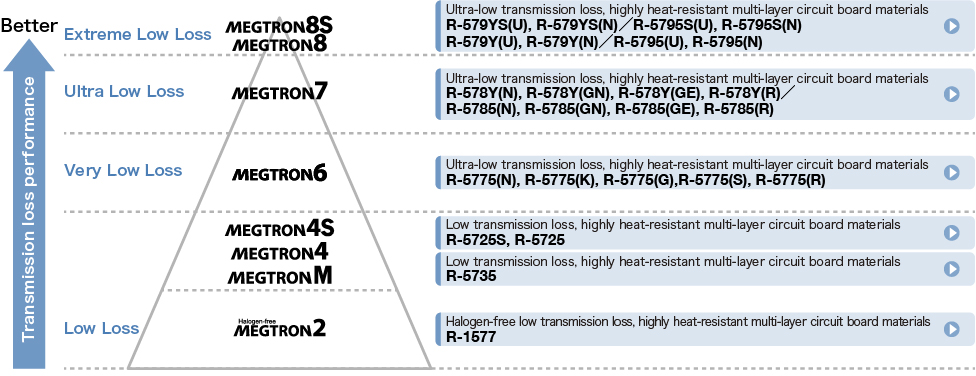
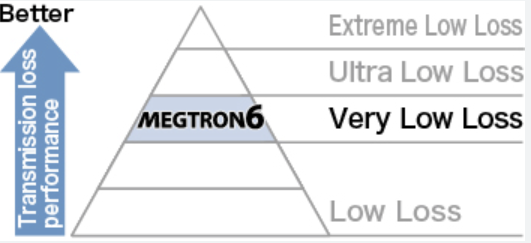 Panasonic's brilliance lay in its clear generational product mapping:
Starting from M2 and M4 as entry-level high-speed materials, progressing to M6 and M7 tailored for the explosion of data centers and AI servers, moving up to M8 designed for next-generation 112G PAM4 and beyond, and finally reaching the flagship M9 featuring Q-glass (Quartz cloth) technology.
Panasonic's brilliance lay in its clear generational product mapping:
Starting from M2 and M4 as entry-level high-speed materials, progressing to M6 and M7 tailored for the explosion of data centers and AI servers, moving up to M8 designed for next-generation 112G PAM4 and beyond, and finally reaching the flagship M9 featuring Q-glass (Quartz cloth) technology.
Every increase in the "M number" corresponds to a lower Dissipation Factor (Df), a more stable Dielectric Constant (Dk), and higher thermal resistance. When computing giants like NVIDIA explicitly adopted the "Panasonic M9 + Q-glass + HVLP copper foil" solution as the "standard answer" for high-frequency, high-speed PCBs in their next-generation AI server architectures (such as the Rubin architecture), this coding system became deeply embedded in the component selection logic of the entire tech supply chain.
From a technical evolution standpoint, the early M2 and M4 already qualified as high-speed materials. So why are M1, M3, and M5 missing? This gap is actually the result of both technical progression and commercial strategy.
Simply put: M1, M3, and M5 never existed in the market. The M6 we know today is actually a new starting point after Panasonic reorganized its product line to align with the demands of the high-speed digital age.
M2 and M4 are early Panasonic products classified as entry-level and mid-to-high-speed materials, distinct from standard FR-4.
Panasonic's MEGTRON naming convention is not sequential but follows an internal strategy of "performance generations + even-number priority":
Note: The subsequent appearance of M7 and M9 was actually driven by extreme market and client demands for hyper-segmentation. M7 filled the gap between M6 and M8, while M9 represents the absolute pinnacle above M8.
The core reason lies in the explosion of transmission rates and the step-function leap in performance:
Will there be an M10 level material in the future? Absolutely. As 6G and Co-Packaged Optics (CPO) technologies advance, material limits will continue to be broken.
Yes, Q-glass is Quartz Cloth.
This is a fiberglass cloth woven from fibers drawn from high-purity quartz, specifically applied to ultra-high-end, ultra-low-loss high-speed PCB boards. Compared to standard fiberglass or Low Dk (LD-glass) fiberglass, Q-glass boasts a lower and much more stable Dk value, alongside an extremely low Df value. This minimizes signal distortion under ultra-high-frequency, long-link transmissions. Top-tier computing boards like NVIDIA's GB200 must utilize Q-glass specifications.
First, Panasonic defined a remarkably clear roadmap for technological evolution. While the rest of the industry was still using vague terms like "low loss" or "ultra-low loss," Panasonic directly correlated the numerical differences of M6 and M8 with distinct speed grades.
Second, the explosion of AI computing power turned the M series into a de facto performance benchmark. Once NVIDIA confirmed its use of M9-grade solutions, the entire supply chain had no choice but to align with this standard. To enter the top-tier supply chain, CCL manufacturers across Taiwan and Mainland China aggressively launched products benchmarking the performance of M6, M7, and M8. Over time, the "M numbers" shed their single-brand trademark status and evolved into the "universal language" used globally by the PCB industry to describe high-speed material grades.
| Equivalent Grade | Panasonic Standard | Dissipation Factor Df (@10GHz) | Representative Asian Mfrs (Partial) | Mfr Corresponding Series (Ref) | | :--- | :--- | :--- | :--- | :--- | | Low-to-Mid Loss | M6 | 0.003 ~ 0.004 | Shengyi / Nanya / Huazheng | S7439 / NE-VL / H5 | | Ultra-Low Loss | M7 | 0.002 ~ 0.0025 | EMC / Shengyi / Nanya | EM-892 / S8939 / NE-VL | | Extreme-Low Loss | M8 | 0.0015 ~ 0.0018 | Shengyi / Nanya / Huazheng | S1G / NE-VLL / HSD8 | | Supreme Ultra-Low Loss | M9 (Q-glass) | 0.0009 ~ 0.0013 | Shengyi / Nanya / Huazheng / Dongcai | S10939 / NE-VLL(Q) / HSD9Q / DT-M9 |
Note: Brand specifications and formulas, such as hydrocarbon resin + Q-glass technologies, are continuously updated. Specific values should be verified against the latest Data Sheets from the respective manufacturers.
As the saying goes, "There is no path in the world, but when many people walk it, a path is formed." A company with robust technical capabilities that gains widespread recognition from top-tier clients naturally becomes the rule-maker and the industry benchmark.
Whether you are developing high-frequency communication modules or designing hardware for next-generation AI servers, eCloud provides the most professional PCB prototyping and manufacturing services. From economical M6-grade high-speed solutions to the ultimate M9 + Q-glass top-tier processes, we have extensive material reserves and engineering expertise to help bring your projects to life rapidly. Feel free to contact our engineering team anytime for the latest material selection advice!