April 24, 2026
Hello everyone! Welcome to our latest material science breakdown. In today’s era of ultra-high bandwidth and blazing-fast internet speeds, whether we are talking about the highly anticipated AI servers (like those powered by NVIDIA GB200 chips), 5G/6G base stations, or low-Earth orbit (LEO) satellite communications, the industry is relentlessly pursuing "faster speeds, greater stability, and lower latency." But did you know? In these cutting-edge tech devices, the choice of base materials often dictates the absolute performance ceiling of the final product.
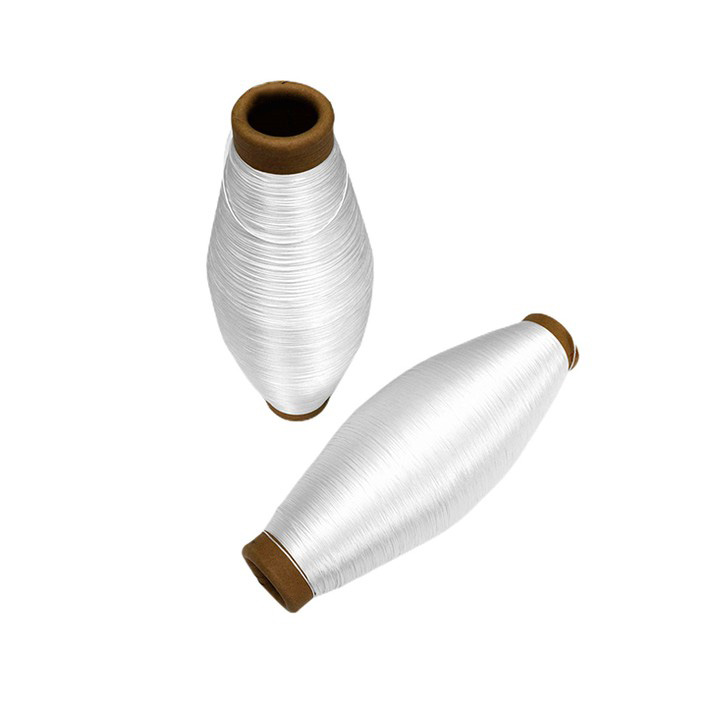 Quartz Fiber
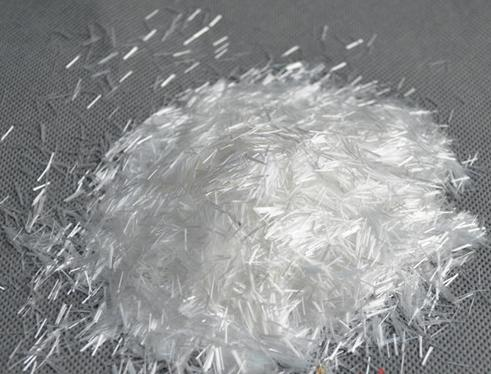 E-Glass
Through a detailed comparison of features and data tables, we will help you grasp their core differences so you can make precise, informed decisions for your future projects!
The characteristics of a material are destined from its original formulation. While all three of these fibers are spun into existence, what's inside them varies drastically.
| Material | Composition | Purity | Raw Materials | Market Positioning | | :--- | :--- | :--- | :--- | :--- | | E-Glass (Standard Electronic Grade) | Contains about 52% ~ 56% Silicon Dioxide (SiO₂), along with various metal oxides like boron, aluminum, calcium, and magnesium. | Standard industrial grade with relatively higher impurities. | Standard glass marbles, pyrophyllite, etc. | The general-purpose foundational fiber. It's the industry's "jack-of-all-trades," satisfying the vast majority of electronic products that don't have stringent high-frequency requirements. | | Low-Dk Glass (Low Dielectric Electronic Grade) | Significantly higher SiO₂ content, with specifically reduced boron and alkali metals. It relies on a specially modified formulation. | Medium-to-high, specifically targeting the reduction of impurities that negatively impact dielectric properties. | Specially modified glass batches. | Exclusively for mid-to-high-end high-speed PCBs. It is an advanced material born to meet the demands of high-speed transmission protocols like PCIe 4.0/5.0. | | Quartz Fiber (Q-Glass Grade) | SiO₂ content reaching an astonishing 99.95% ~ 99.998%. It is almost pure silica! | Ultra-high purity, with alkali metal content typically under 10ppm. | High-purity quartz sand or crystal materials. | The absolute highest-end, ultra-low dielectric, high-temperature specialty material. It's the "hypercar" of the materials world, designed for scenarios that push the boundaries of physics. |
In the high-speed electronics realm, the two parameters we care about most are the Dielectric Constant (Dk) and the Dissipation Factor (Df). A lower Dk means signals travel faster through the circuit board; a lower Df means less signal attenuation and loss during transmission.
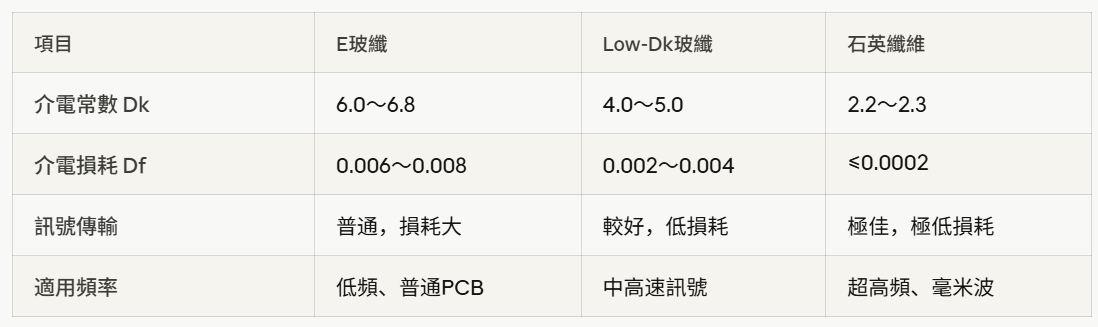
Data Insight: Looking at the table, Quartz Fiber's Df value at 10GHz is nearly 50 times lower than traditional E-Glass! This means that at extremely high frequencies (like mmWave or 6G), only Quartz Fiber can ensure total signal integrity and prevent data loss caused by thermal dissipation.
PCBs generate heat during operation. If the base material's Coefficient of Thermal Expansion (CTE) is too high, it can easily lead to board warpage or even fracture the internal micro-vias.
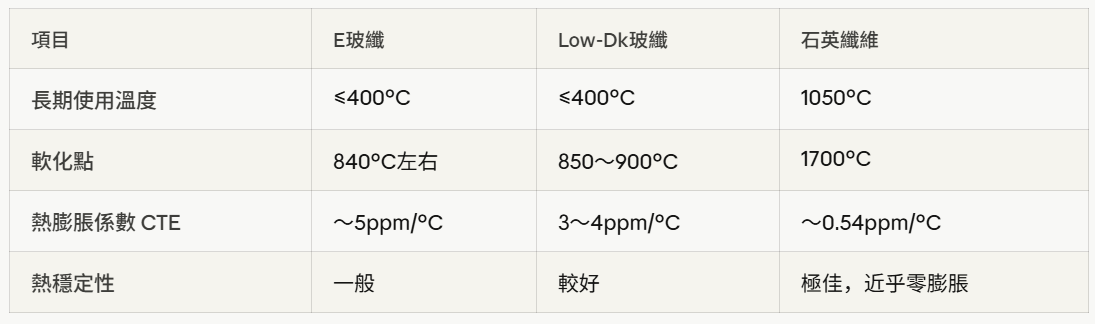
Data Insight: Quartz Fiber has a CTE of just 0.54 ppm/°C, making it virtually immune to thermal expansion and contraction. This provides an irreplaceable advantage for high-precision IC Substrates and advanced packaging processes.
While Quartz Fiber dominates in electrical and thermal metrics, let's also examine their physical structural differences.
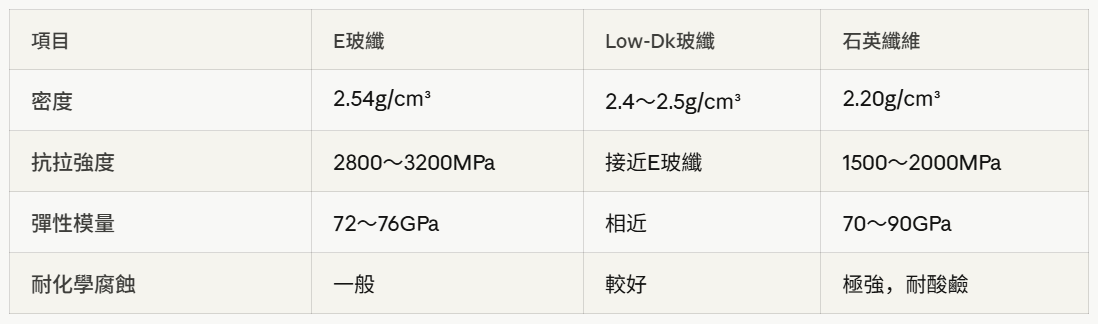
Data Insight: Moisture is the ultimate killer of PCB dielectric performance. Quartz Fiber's incredibly low water absorption ensures that it maintains stable, high-frequency electrical performance even in harsh and humid environments.
The unique properties of these materials dictate their best use cases in the market:
Finally, we have to face the realistic consideration of Cost.
| Material | Relative Cost Level | Manufacturing Difficulty | | :--- | :--- | :--- | | E-Glass | Low | Highly mature, massive economies of scale. | | Low-Dk Glass | Medium-to-High | Complex formulation/drawing processes, challenging yield control. | | Quartz Fiber | Extremely High (several to dozens of times) | Difficult raw material acquisition, requires >2000°C melting, extremely high production difficulty. |
To sum it up, there is no perfectly absolute material, only the "most suitable" choice.
Hopefully, this breakdown helps you clearly understand the differences between these three core materials! If you found this article helpful for your work or studies, don't forget to share it with your fellow engineers and colleagues. See you next time!