April 23, 2026
Since November 2025, laminate manufacturers have been rolling out price hike notices one after another without hesitation. Entering 2026, this upward trend has continued month over month, advancing aggressively. As of now (April 2026), a 30% increase is merely the baseline. Some specific high-frequency/high-speed materials (like the TU-863+ and Rogers series) and Prepreg (PP) have skyrocketed by over 80%. To be fair, laminate manufacturers are in a tough spot too, as upstream raw materials for CCL (Copper Clad Laminate) are surging faster than anyone can react: ●LME Copper: Spiking significantly. ●Copper Foil: Tracking LME copper prices closely. ●Fiberglass Cloth: Skyrocketing like a rocket. ●Resin: Experiencing across-the-board increases. When CCL goes up, PCB fabs have no choice but to bite the bullet and follow suit. But exactly how much more does a PCB cost in this brutal wave of price hikes? Today, let's unpack the PCB cost structure and do the math.

Simply put, PCB costs are divided into two main chunks: Raw Materials (approx. 60%) and Manufacturing Costs (approx. 40%, including labor, energy, equipment depreciation, etc.).
Within that 60% material cost, CCL is undoubtedly the largest expense.
There is, of course, one exception: boards with large ENIG (Electroless Nickel Immersion Gold) areas, localized thick gold plating, or heavy gold fingers.
When international gold prices were around $400, standard ENIG (covering less than 20% of the board) typically added about $150-$200 to the lot. Back then, the surface finish process only accounted for 3-5% of the total cost.
Those days are gone.
With gold prices having roughly tripled, standard ENIG processing now costs closer to $400-$500, pushing its cost share up to 10%-15%. This completely overturns past conventions. For large gold areas or thick gold, the cost of gold salts can easily surpass the laminate itself, becoming the largest line item.
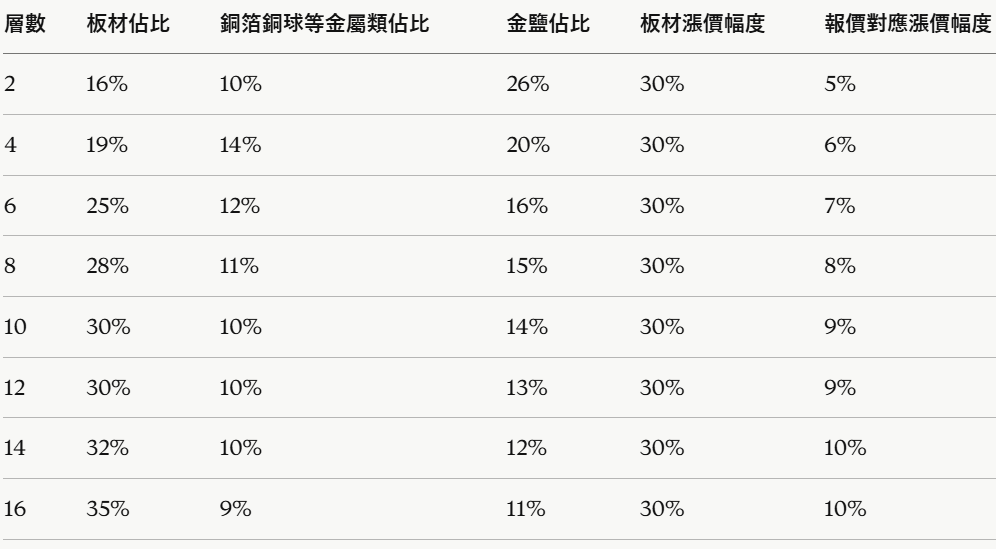
For standard boards (FR4 material, regular through-hole process, <20% ENIG area), the material cost ratio by layer count generally trends as follows:
(Note: Actual PCB material costs fluctuate by ±5% depending on stackup design and panel utilization/yield.)
Let's use a standard theoretical pass-through formula:
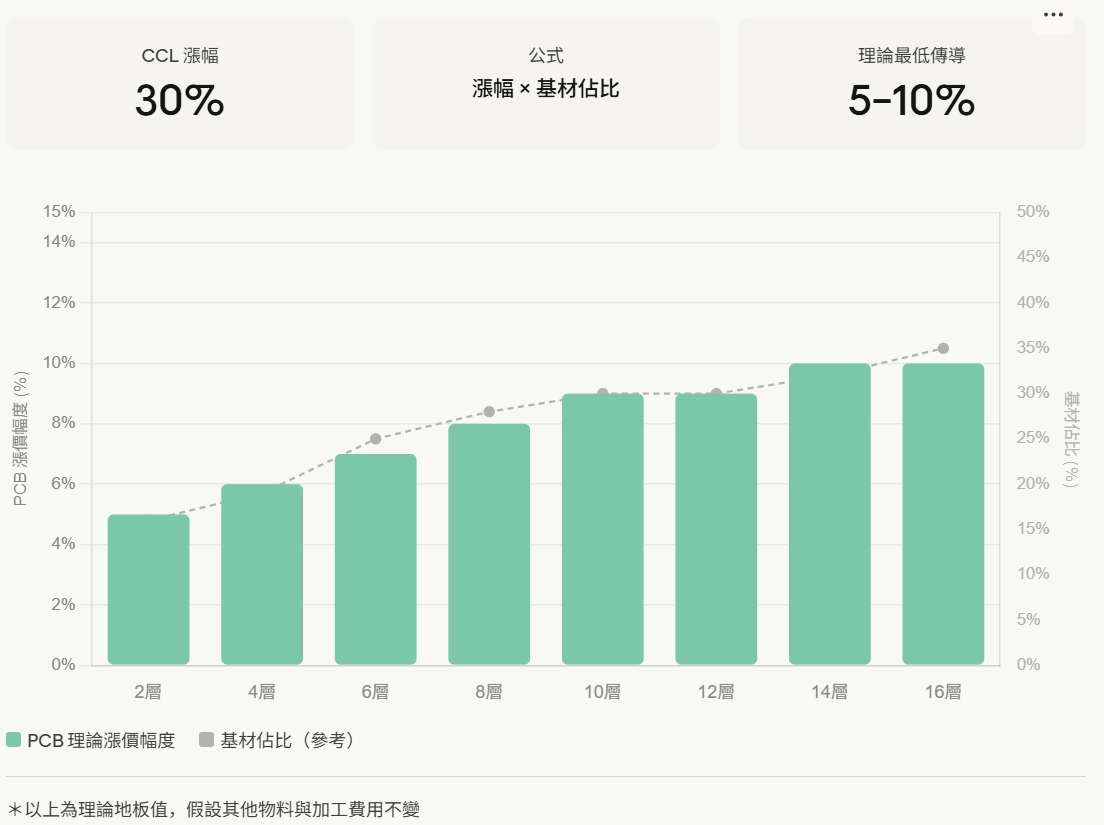
Theoretical PCB Price Increase ≈ Laminate Price Increase × Laminate Cost Ratio
Using a 10-layer board as an example:
30% (Laminate Increase) × 30% (Laminate Ratio) = 9%
In a perfectly ideal scenario (where no other materials rise and manufacturing costs remain static), a 30% jump in CCL pushes the PCB quote up by 9%. This means if a board was originally $100, it now needs to be sold at $109 just to maintain the original gross margin.
For a 2-layer board, the theoretical minimum increase is around 5%. However, whether it's 5% or 9%, this is strictly the "floor price." Real-world production pressures are much heavier.
As shown at the beginning, laminate isn't the only material getting more expensive:
Factoring all this in, a 15% PCB price increase is actually quite conservative. If you are dealing with thick copper, scarce high-frequency materials, large copper pours, thick gold, or boards that look like Swiss cheese due to extreme via counts (like high-end HDI or designs requiring POFV resin plugging)—a 50% price hike is not uncommon at all.
Fabs aren't just blindly inflating quotes. When calculating the BOM in our own ERP systems, we often second-guess our math, double-checking and cross-verifying repeatedly to ensure we aren't unfairly charging the client.
Of course, there are exceptions where the price hike isn't as steep: For high-end, high-layer-count products with naturally larger profit margins, absorbing a 3-5% material cost increase is manageable. This is why top-tier fabs are more resilient, while those competing in the low-end red ocean look fragile, as they were already surviving on razor-thin margins.
Additionally, for clients who communicated well and accepted phased price increases early on, the initial shock wasn't heavily scrutinized. But now in 2026, as fabs face comprehensive cost pressures across the board, projects that previously avoided price hikes will have to catch up all at once. Seeing a sudden 30% to 50% jump in those cases is entirely expected.
This massive wave of price increases is violently reshaping profit distribution across the industry:
PCB fabs must optimize stackup designs, improve yield rates, and rely on automated management to digest costs internally. This poses a massive challenge to production efficiency and cross-departmental communication. Failing to do so means watching profits erode. Fabs with high technical barriers (like advanced HDI) have fewer competitors and plenty of orders, while low-end manufacturers suffer from both fierce price wars and material starvation.
As for the downstream (Terminal Brands), it's harder to generalize. Between a bare PCB and the final consumer product, there are multiple assembly and integration stages. It's highly possible that the cost pressure gets diluted layer by layer, leaving the end consumer relatively unaffected.
While this looks like a straightforward cost structure analysis, simply "raising prices" won't permanently solve the challenges PCB fabs are facing.
This material shortage, ignited by the explosion of AI computing demand, is projected to last well into 2027. "He who controls the materials controls the market" has become the undeniable new rule of survival in the PCB industry.