February 27, 2026
ENIG (chemical gold plating), OSP, and tin plating: which is the most cost-effective option for prototyping and mass production?
In PCB procurement decisions, Surface Finish is often treated as just another "option" on a quotation sheet. However, for experienced procurement professionals and Project Managers, this is actually a "Financial Decision" concerning production yield, assembly costs, and inventory risk. As electronic components move towards 0201 and even smaller packages, coupled with the continuous reduction in BGA ball pitch, the choice of surface finish is no longer simply about "rust prevention"; it directly dictates the difficulty and rework rate of the subsequent SMT (Surface Mount Technology) process.
This report will provide an in-depth analysis of the economic models of three mainstream surface finish technologies—HASL, OSP, and ENIG—guiding you to identify the hidden costs lurking beneath the simple per-unit price.
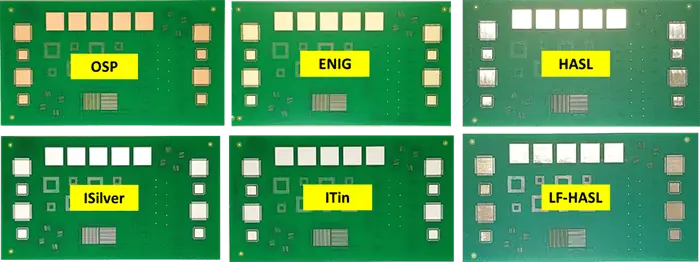
HASL is one of the oldest processes in the PCB industry, involving immersing the board in molten solder and then using high-pressure hot air (air knives) to level the surface.
OSP uses a chemical method to grow an extremely thin, transparent organic complex layer on the bare copper surface.
ENIG consists of a dual-layer metal structure: a Nickel layer (3 - 6 μm) and a thin Gold layer (0.05 - 0.1 μm).
Procurement cannot just look at the "processing cost per square meter"; the "Total Cost of Ownership (TCO)" must be considered.
ENIG pricing is highly dependent on international gold prices. In recent years, volatile precious metal prices have made ENIG costs a dynamic pricing mechanism. For Procurement PMs, locking in mass production orders during a gold price peak can make the cost premium of ENIG 40% to 60% higher than OSP.
While OSP has a low unit price, its yield stability in complex processes is lower. Industry data indicates that OSP boards have a significantly higher risk of solder joint failure due to poor wetting after multiple thermal cycles compared to ENIG. If the product is a high-value multi-layer board or a server motherboard, the $1-$2 processing cost saved per unit is often completely negated by a 1%-2% yield loss.
This is the blind spot most easily overlooked by procurement: OSP is a "non-conductive" organic film. During In-Circuit Testing (ICT), probes must pierce through the OSP film to contact the copper. This "bed-of-nails testing nightmare" leads to two problems:
For the ENIG process, the most troublesome issue for R&D and Quality Control teams is the "Black Pad" phenomenon.
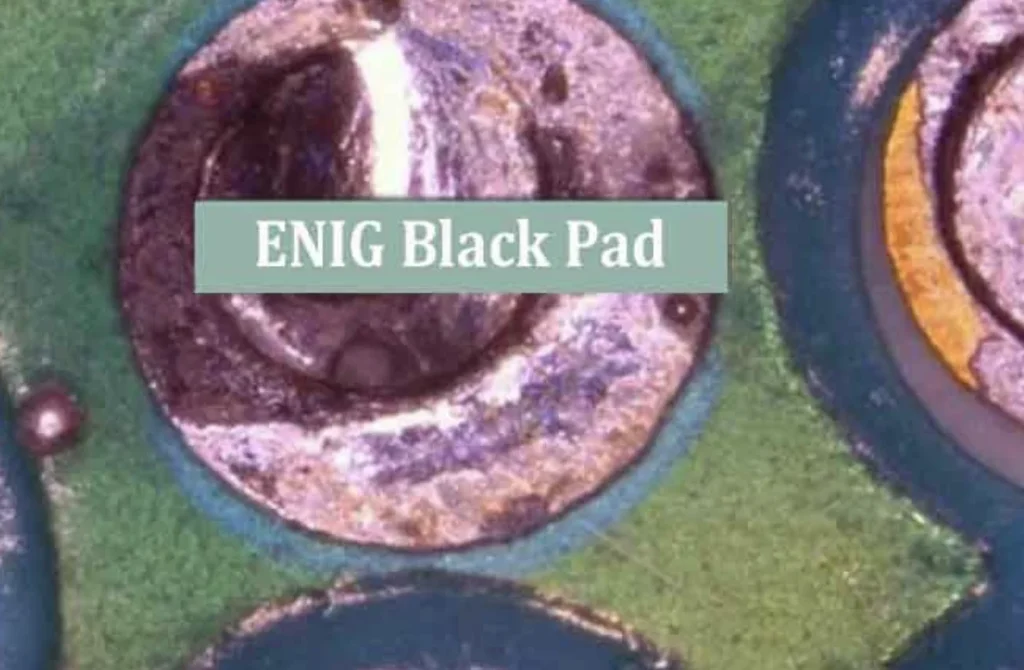 What is "Black Pad"?
During the ENIG process, if the immersion gold reaction is too aggressive, it causes excessive corrosion and embrittlement of the underlying Nickel layer at the interface. This defect is extremely difficult to detect with X-ray and typically manifests months after product shipment and use, when mechanical vibration causes sudden solder joint fracture.
What is "Black Pad"?
During the ENIG process, if the immersion gold reaction is too aggressive, it causes excessive corrosion and embrittlement of the underlying Nickel layer at the interface. This defect is extremely difficult to detect with X-ray and typically manifests months after product shipment and use, when mechanical vibration causes sudden solder joint fracture.
| Decision Dimension | Prototyping Stage | Mass Production Stage | High-End / Extreme / High-Frequency Applications | | :--- | :--- | :--- | :--- | | Preferred Finish | ENIG | OSP | ENEPIG / Hard Gold / (OSP for High-Freq) | | Key Consideration | Solderability tolerance, manual assembly friendliness | Absolute unit price, process maturity | Lifespan, Signal Integrity | | Strategic Rationale | Prototypes often require repeated soldering/desoldering and component debugging. ENIG's high planarity and multiple rework capabilities save R&D significant troubleshooting time. | When the production chain is stable, with Nitrogen reflow protection and assembly completion within 24 hours, OSP offers extreme cost advantages. | For extreme environments, choose ENEPIG to prevent Black Pad. For very high-frequency applications like 5G/mmWave, OSP can be a better choice to avoid signal loss caused by the skin effect in the Nickel layer. |
Before approving a quotation, Procurement and PM should verify the following three points with R&D:
In summary, a "cost-saving solution" for PCB surface finishes does not exist on a simple quotation sheet. Insisting on ENIG during the prototyping stage is an investment in R&D efficiency; conditionally switching to OSP during mass production is a demonstration of supply chain management capability.
As a hardware development accelerator, eCloud Technology possesses full-series process capabilities from standard ENIG to high-end ENEPIG. Through data-driven DFM pre-reviews, we assist Procurement and R&D in finding the optimal balance between cost and performance. Choosing the right surface finish is not just about protecting your budget; it's about safeguarding the reliable quality of your product in every moment it spends in the customer's hands.