March 23, 2026
In our interactions with the engineering community on the eCloud PCB Prototype platform, we often observe a common pattern: when encountering a routing bottleneck, engineers tend to instinctively add blind vias or buried vias. This seemingly simple mouse click in EDA software triggers a series of complex manufacturing processes during physical production, leading to a sharp increase in prototyping costs. As component density increases, the adoption of High-Density Interconnect (HDI) technology has become an engineering necessity. However, for many R&D and PM teams, finding the optimal balance between technology and cost within limited space remains a major challenge. This article will break down the logic behind the cost multiplier associated with HDI levels and explore exactly how much a team can save during the prototyping phase by reducing the number of “levels” used.
To accurately calculate costs, one must first understand the concept of "Stage" (or Build-up). In traditional PCBs, regardless of the number of layers, drilling is done once through the entire board. HDI, however, uses microvias and buried vias to connect only specific adjacent layers.
A "1-Stage" process means the factory must first laminate the inner layers and create buried vias, then add material to the top and bottom, drill microvias using a laser, and laminate again. When the design requires "2-Stage," the factory must repeat the above build-up and laser drilling process. Each increase in stage represents repeated physical and chemical processing.
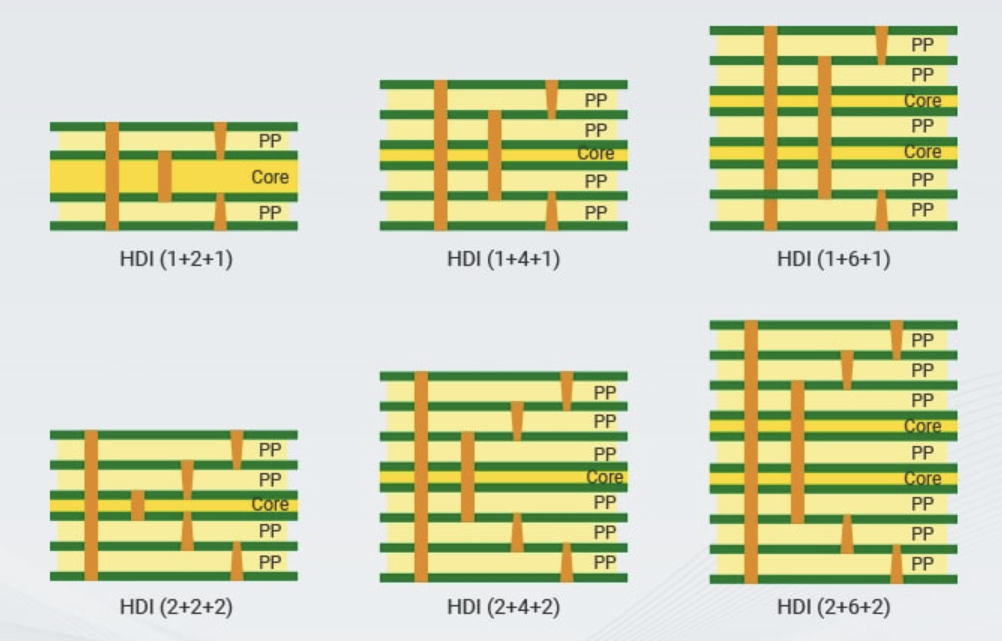
According to common PCB manufacturing quotation data in the industry, there is a significant non-linear relationship between the increase in HDI stages and the price. Each additional lamination and laser drilling cycle substantially drives up manufacturing costs. More importantly, the quotation is often overlooked: Yield Rate.
| HDI Stage | Cost Impact | Yield Rate | | :--- | :--- | :--- | | Base (Through-hole Base) | Baseline Quotation | N/A | | 1-Stage | +30% ~ +50% | 98% | | 2-Stage | +80% ~ +120% | 95% | | 3-Stage | Often >2x | 88% |
In actual production, with each additional chemical plating and high-temperature lamination cycle, the risk of unclean desmear at the bottom of microvias or misalignment between layers increases dramatically. To ensure that enough prototype boards can be delivered, the factory must produce more base panels to absorb scrap losses, and these additional costs are converted into the high numbers on the quotation.
Taking a basic through-hole board with an original prototype cost of approximately NT$4,500 as an example, once a 2-stage HDI design is introduced, the quotation might jump directly to NT$8,000 to NT$10,000. Especially during the Prototype stage, this cost-doubling effect is further amplified by NRE fees (such as engineering setup charges, artwork, and test fixtures).
We encountered a real project where the team re-evaluated the routing and optimized the design to reduce the stage, successfully bringing down an original quotation of over NT$52,000 to around NT$35,000. This single prototyping run immediately saved the company nearly 34% of the development budget.
Reducing a stage essentially moves the project from a high-risk yield back to the safe zone of stable processes. Engineers can optimize from the following dimensions:
The quotation multiplier for blind and buried vias is not arbitrarily fabricated by board houses; it is an objective cost deeply rooted in the physics and chemistry of the manufacturing processes. While pursuing hardware design, integrating cost calculation thinking into every microvia allows the team to create truly competitive, high-performance products.
Unsure what HDI stage your current design requires? Or want to see the real quotation difference after reducing a stage? Upload your Gerber files to the eCloud platform now. Through our automated DFM check and instant quoting engine, you can immediately compare the prototyping cost differences under various processes and stages, spending every bit of your R&D budget wisely and paving a smooth road to mass production with high yields and a stable supply chain.