June 20, 2026
Looking back at the global printed circuit board (PCB) market in 2025, "AI" was undoubtedly the core keyword. Benefiting from the robust demand for AI infrastructure, the global bare board market scale jumped from $73.6 billion in 2024 to $85.8 billion in 2025. The overall market's annual growth rate reached a high of 16.7%. However, if we break down this apparent feast, we will find it was a highly asymmetric battle.
In the 2025 growth, profits and orders rapidly concentrated among a few players mastering advanced manufacturing processes.
This sends a clear signal to the market: the era of relying on low‑end commodity boards (which saw only a marginal growth of 6.2% in 2025) is over.
To meet the massive computing power and high‑speed transmission demands of AI data centers, sophisticated large‑panel and high‑density interconnection designs have become standard for high‑end projects.
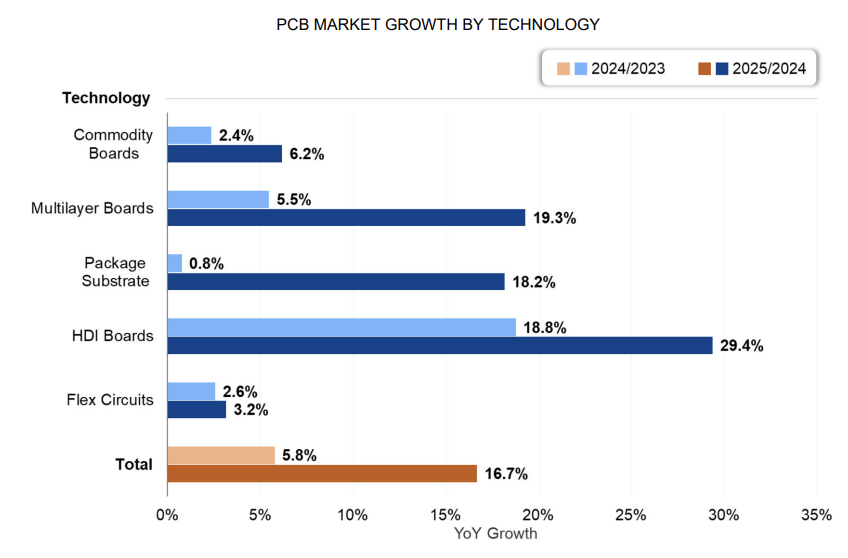
High‑end HDI products achieved an explosive 29.4% growth in 2025. This surge was primarily driven by robust demand for AI computing boards, high‑end networking, optical modules, and satellite communications. Multilayer boards (MLB) overall also experienced a 19.3% expansion. Among them, HLC boards with more than 18 layers saw a staggering growth of over 80%.
In many practical high‑frequency prototyping projects, we have seen specifications pushed to complex 22‑layer stack‑ups. Meanwhile, in Any‑Layer and special flexible circuit board designs, engineering teams increasingly tend to precisely set the copper thickness target at 35 μm to perfectly balance yield and high‑frequency transmission quality.
After two challenging years, the substrate market ushered in a robust 18.2% recovery in 2025. This was largely driven by the continued advancement of advanced packaging for GPUs, CPUs, and ASICs. Many top‑tier substrate suppliers even saw revenue growth of 20% to 30%.
Compared to the success of rigid boards, the FPC market remained weak overall due to stagnant consumer electronics demand and macroeconomic inflationary pressures. Many leading FPC suppliers even faced negative growth in 2025.
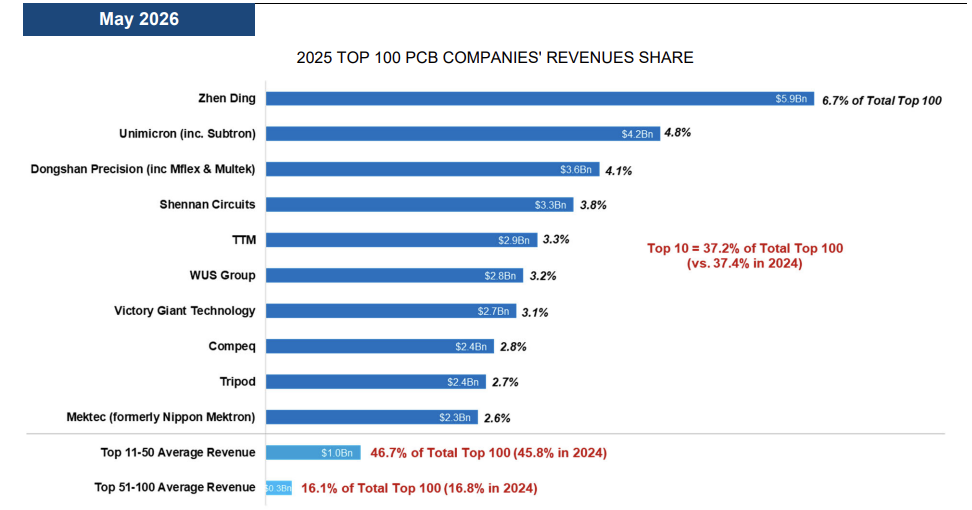
From the 2025 Top 100 Global PCB Companies list, we can clearly see Asia's absolute dominance in global hardware manufacturing.
In the Top 100 list, although Taiwan had 21 companies featured, they accounted for approximately 30% of the total global production value. Notably, at the very top of the rankings, Taiwan's Zhen Ding and Unimicron captured the global number one and number two leadership positions respectively.
Chinese enterprises occupied 43 seats on the Top 100 list. It is estimated that Chinese PCB manufacturers' total production value accounted for 36% of the global market, maintaining its position as the world's largest production base.
2025 was a highly rewarding year for the PCB industry, with the Top 40 companies achieving an average net profit margin of 8.3%. Aggregate net profits surged by 55% year‑over‑year. Flush with cash, these top‑tier companies drastically increased their capital expenditures (CAPEX) by 27%, with the CAPEX‑to‑sales ratio rising from 14.9% in 2024 to 15.6% in 2025.
To reduce reliance on a single region, massive amounts of this capital flowed into Southeast Asia, making Thailand, Vietnam, and Malaysia the biggest beneficiaries of this high‑end capacity transfer.
Facing the tectonic shifts brought about by AI infrastructure, how should Taiwan's tech companies and R&D teams seize these dividends?
Facing increasingly stringent HDI and HLC manufacturing challenges, the cost of fighting alone is exceedingly high. Actively building partnerships—such as collaborating with top academic institutions like NTU's engineering departments to tackle front‑end materials science—is the long‑term solution to resolving high‑frequency transmission physical bottlenecks.
As overseas (especially Southeast Asian) supply chains gradually take shape, future B2B business development must be more aggressive. Seize international benchmark exhibitions like Computex to precisely connect with international enterprise clients seeking alternative supply chains for high‑end manufacturing.
Cross‑border capacity transfers and the expansion of high‑end product lines imply highly complex team collaboration and quotation processes. Only by fundamentally optimising internal ERP and project management architectures can you ensure that every delivery, from front‑end prototyping to back‑end mass production, maintains the highest standards of quality.
Sources: NTI-100 Global Top 100 PCB Ranking (2024, Hayao Nakahara / TPCA), Prismark Partners 2025 Market Report. Market size is based on bare‑board value; company value shares are calculated by company nationality (not production location).