From Tg to Assembly and Long-Term Reliability
Check test methods, thermal expansion, and operating conditions to define the material specification.
Writing “FR-4, Tg170” in an inquiry can still leave two questions unanswered: which test method produced that Tg, and what temperature exposure must the product actually withstand?
Brief heating during reflow differs from sustained heating over years of operation. Combining these conditions can turn a single material value into an assumed reliability guarantee for the entire PCB.
Tg is an important parameter, but R&D teams need the following five checks to establish a specification that can be sourced, fabricated, and verified.
Tg is the glass transition temperature. For common glass-reinforced epoxy laminates, it describes a transition in resin mechanical properties over a temperature range, represented by a temperature determined using an agreed method.
It is not the temperature at which the board melts, nor is it a finished product’s continuous operating-temperature rating.
Technical reference: Isola: Understanding PCB Glass Transition Measurements by DSC
When comparing materials, check the method:
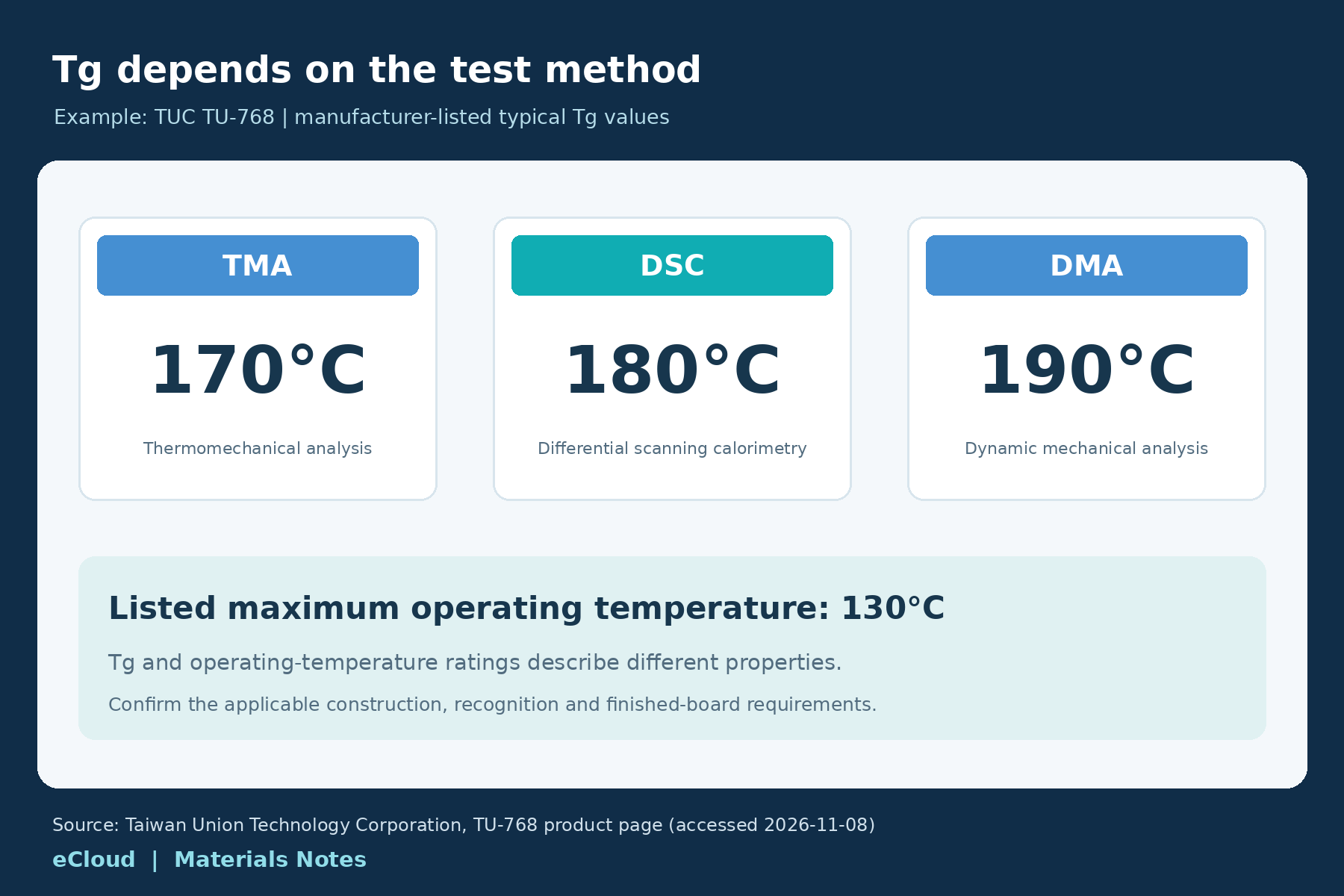
TUC’s TU-768 information lists different Tg values for these three methods. Specify the method in purchasing requirements rather than comparing or converting values across methods without a defined basis.
Material example: TUC TU-768
Reflow assessment needs peak temperature, exposure time, processing cycles, and possible rework. Tg alone does not answer all these questions.
Two additional parameter groups commonly appear in material datasheets:
These parameters describe different behaviors. They cannot replace one another or be converted directly into a number of successful product reflow cycles.
Data example: Isola I-Speed Material Properties
Panasonic’s published HIPER data also shows that Tg and Td do not rank different materials in the same order. Selecting a higher Tg still requires a separate Td review.
Comparison reference: Panasonic HIPER Material Data
Resin, glass, and copper expand differently as a PCB heats. Above Tg, faster resin expansion can increase structural stress. Excessive Z-axis expansion can place additional loads on via structures.
Technical reference: Altera: PCB Glass Transition Temperature and Expansion
Review separately:
CTE in ppm/°C and total expansion in percent are different metrics; their numerical magnitudes cannot be compared directly.
Increasing Tg may contribute to an improved material combination, but actual expansion data, construction, and processing still need review. A material designation does not replace via and finished-board reliability validation.
Surviving brief assembly heating and operating continuously in a specified environment are separate thermal-reliability requirements.
Technical reference: Isola: Assembly and Operating-Environment Thermal Reliability
Manufacturers may separately list a maximum operating temperature, or MOT. TU-768, for example, lists operating temperature separately from Tg. Confirm the applicable construction and recognition conditions before using such information.
Before selection, establish:
Subtracting a fixed temperature margin from Tg does not establish a universal continuous operating limit for all materials and products.
Materials with equal Tg still require separate assessment of electrical properties, moisture behavior, expansion, processing, and availability.
High-speed designs need Dk, Df, foil, and actual stackup review. Thermal management requires separate consideration of conductivity and system heat flow. These properties cannot be inferred from Tg.
For quotations or substitution discussions, provide:
Compare alternatives item by item, then confirm available thicknesses, prepreg combinations, and fabrication conditions. “Equivalent Tg permitted” can omit properties on which the original design depends.
PCB Tg selection should align transition behavior, assembly endurance, thermal expansion, and long-term operating conditions.
Where information is incomplete, document operating and validation requirements first, then review candidate grades with material suppliers and fabricators. This supports a more traceable decision than simply increasing the Tg number.
For an eCloud PCB prototype inquiry, provide Gerbers, the stackup, fabrication requirements, and quantities. Identify mandatory materials, the Tg method, and substitution restrictions to support review of fabrication conditions, pricing, and lead time.