March 13, 2026
With the rapid advancement of artificial intelligence (AI), high-performance computing (HPC), and low-Earth orbit (LEO) satellite communications, demands for miniaturization and signal integrity in electronic devices have reached unprecedented levels. Traditional PCB design primarily focused on the layout of surface-mount technology (SMT) components. However, as Moore's Law approaches its physical limits, “two-dimensional routing” can no longer meet the spatial requirements of modern high-frequency circuits. Embedded Components Technology (ECT) has emerged as the ultimate solution for reducing system footprint. Integrating materials science, precision thermal management, and advanced process reliability, this technology represents not only a technical breakthrough but also a critical battleground for Taiwanese PCB manufacturers. It enables them to capture high-end orders and establish technological moats while navigating global price competition.

For R&D engineers, the core significance of miniaturisation lies in shortening signal transmission paths and increasing computing density. The closer the components are to the main chip, the lower the signal latency and noise interference. Driven by trends in 5G/6G high-frequency communication and edge AI applications, High-Density Interconnect (HDI) boards combined with embedded components have become an inevitable choice.
According to data from the Taiwan Printed Circuit Association (TPCA), the output value of Taiwan's PCB industry reached NT$1.22 trillion in 2024, with an annual growth rate of 8.1%. AI servers and Low Earth Orbit (LEO) satellites are the main engines driving demand for advanced HDI boards. Taiwanese manufacturers must differentiate themselves through advanced processes like embedded components to avoid being drawn into price wars in the traditional multilayer board market.
| Driving Factor | Technical Requirements | Expected Benefits | | :--- | :--- | :--- | | AI Servers / HPC | High current handling, thermal design | Improved heat dissipation efficiency and power conversion rate | | Low Earth Orbit (LEO) Satellites | High reliability, volume requirements | Reduced connector usage, improved system stability | | Edge AI | High-density passive component integration | Smaller module size, extended battery life | | Automotive Electronics / EV | Thermal expansion matching, vibration resistance | Increased mechanical stress tolerance, protection of critical components |
Embedded components are mainly divided into two categories: "Passive" and "Active." Currently, the technology for embedding passive components is more mature within the Taiwanese industry.

Also known as ECP (Embedded Component Packaging), this involves directly embedding unpackaged chips or bare dies into the PCB substrate. This requires manufacturers to have extremely high alignment accuracy and stringent cleanroom environmental control, as the chips are highly sensitive to heat and stress during the process.
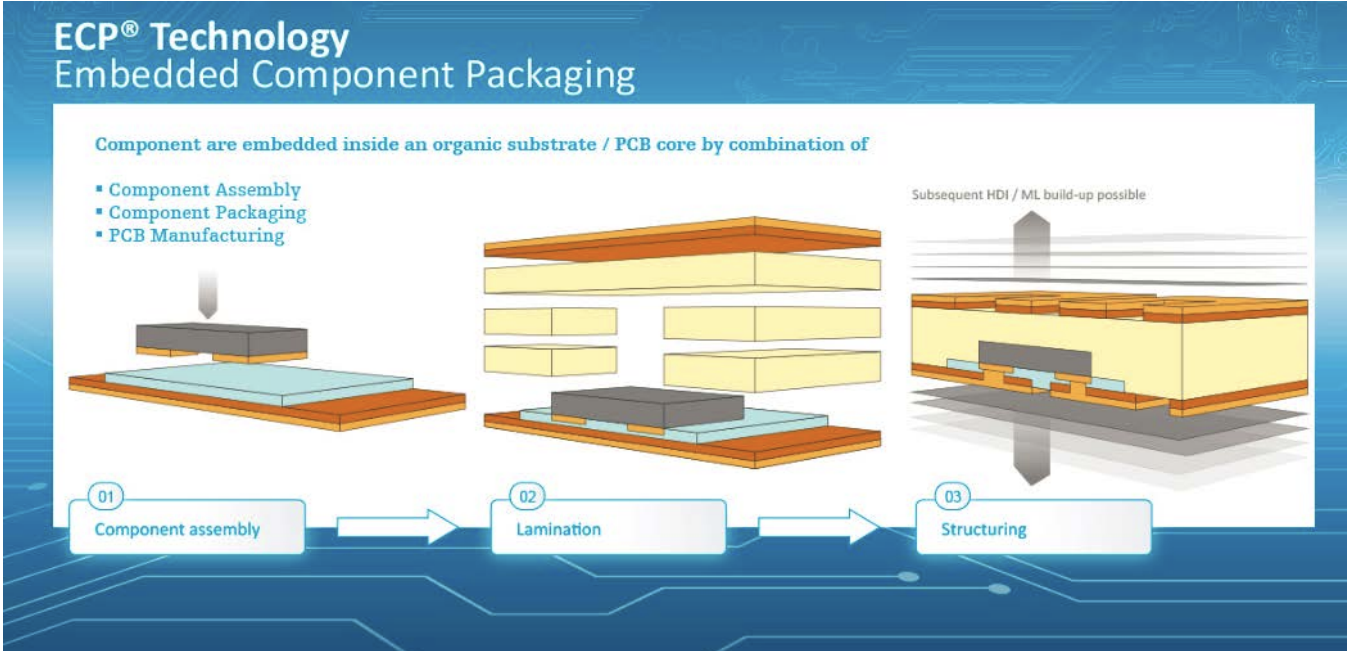
Producing a embedded component PCB involves the following stringent steps:
High-precision SMT placement machines (with accuracy requirements of ±25μm) are used, and components are fixed with non-conductive adhesive to prevent "swimming" (displacement) caused by resin flow during subsequent lamination.
The layers are bonded together under high temperature and pressure. At this stage, resin flow must be strictly controlled to avoid forming voids, which could lead to delamination during subsequent reflow processes.
Laser drilling is used to precisely hit the pads of the embedded components, followed by plated via filling to ensure efficient thermal and electrical conductivity.
Standard FR-4 material has a thermal conductivity of only about 0.3 W/m·K, which is completely insufficient for high-power AI chips. Common strategies employed by R&D engineers include:
Due to the Coefficient of Thermal Expansion (CTE) mismatch between different materials, thermal cycling generates stress, leading to failures such as:
Therefore, products must undergo rigorous testing, including Thermal Shock, Highly Accelerated Stress Test (HAST), and multiple reflow simulations.
For Project Managers, the biggest challenge with embedded components is their "irreparability."
Taiwanese PCB manufacturers still maintain a lead in technology, but their operational strategies are undergoing transformation:
Embedded component PCB technology is an indispensable core capability for modern high-end electronic products. It is not merely about reducing size; it involves the cross-disciplinary integration of electrical design, thermal management, and precision manufacturing.
For R&D, it is the key to achieving signal performance; for PMs, it is the balancing act between cost and yield. Mastering this technology is not only a necessity for Taiwanese manufacturers to maintain profitability within the NT$1.22 trillion industry output but also a crucial foundation for Taiwan's electronics industry as it advances into the AI and space age.