Core Drivers of Supply Chain Restructuring
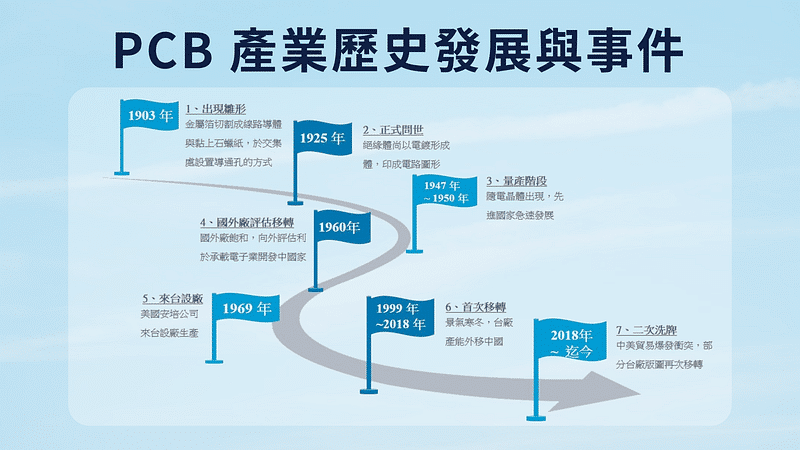
Taiwan's PCB industry has long maintained a "R&D in Taiwan, Production in China" model, with approximately 62% of Taiwanese manufacturers' output value remaining in China. However, the current shift is primarily driven by the following three major factors:
- Long-term Model Transformation: International Tier 1 customers (such as North American cloud service providers and satellite companies) explicitly require the establishment of non-China production backups.
- External Push: The uncertainty of US-China trade friction, coupled with lessons learned from previous supply chain crises, makes risk diversification a necessity.
- Advantages of the Thai Industrial Cluster: Thailand possesses a mature automotive electronics infrastructure, a relatively stable power supply, and policy support, making it the preferred choice for Taiwanese manufacturers.
Comparison of Major Southeast Asian Production Clusters
| Region | Core Technology Positioning | 2025-2026 Development Focus | Advantages & Challenges |
| :--- | :--- | :--- | :--- |
| Thailand | Automotive electronics, Servers, LEO Satellites, HDI | Advanced HDI, AI server motherboards, Substrate division | Complete industrial cluster, large talent gap |
| Vietnam | Consumer electronics, Smart mobile devices, Traditional multilayer boards | Flexible PCBs (FPC), Mid-to-low end HDI, Wearable devices | Proximity to China supply chain, infrastructure needs strengthening |
| Malaysia | Semiconductor packaging substrates, Server power modules | ABF/BT substrates, AI chip support | Mature assembly and test cluster, higher labor costs |
Core Board Manufacturers' Mass Production Progress and Technology Layout
2025 and 2026 represent the "critical examination years" for new factories transitioning from completion to stable yield mass production. The following are key players' dynamics:
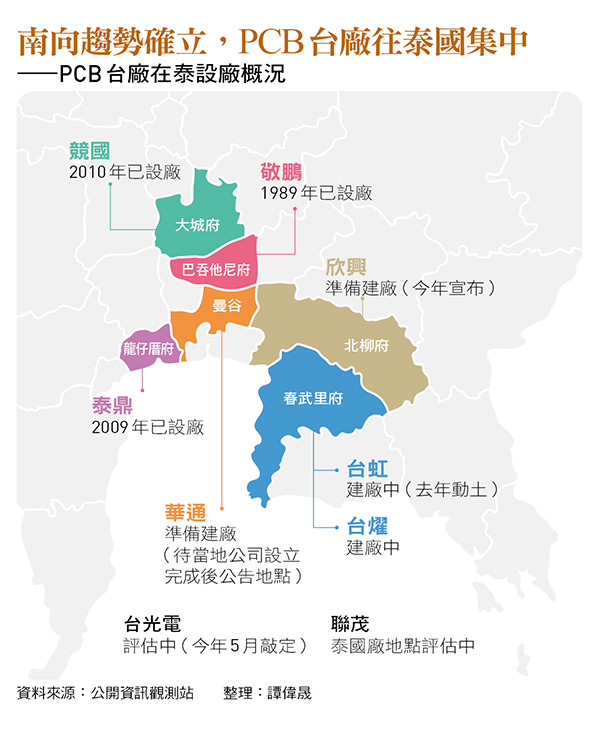
- Unimicron (3037-TW): The Thailand factory commenced operations in August 2024, initially focusing on gaming module boards and LEO satellite products. Capital expenditure was raised to NT$20.6 billion for 2025, with an estimated NT$19.4 billion planned for 2026, focusing on equipment upgrades and capacity ramp-up.
- Zhen Ding Tech (4958-TW): Adopting a large-scale expansion strategy, simultaneously advancing the construction of 10 factory buildings in the Prachinburi Province, Thailand. Capital expenditure is expected to exceed NT$50 billion in 2026, covering AI servers, IC substrates, and HDI boards for edge AI applications.
- Gold Circuit Electronics (2368-TW) : Phase 1 of the Thailand factory began mass production in Q4 2024. The Phase 2 expansion plan is scheduled to gradually release capacity in the second half of 2026 to support strong demand for AI server motherboards.
- Hua Tong (2313-TW): Focuses on advanced LEO satellite and optical communication boards. The Thailand factory is expected to start output in the first half of 2026, prioritizing supply for long-term contract customers and satellite upgrade products (V3, D2C).
Lead Time and Quotation Challenges
Before 2026, lead times and quotations will face structural constraints:
- Equipment Bottlenecks: Supply of advanced equipment like laser drilling machines and vacuum laminators is concentrated, with lead times often reaching 12 to 18 months, limiting the speed at which new factories can ramp up capacity.
- Process Qualification: Environmental control (impact of temperature/humidity on chemicals) and operator proficiency can cause初期 yield fluctuations. Qualification cycles typically require 3 to 6 months.
- Polarized Quotations:
- High-End Products: Affected by copper price fluctuations and rising CCL raw material costs (increases can reach 45%), coupled with supply shortages, quotations remain resilient.
- Standard Products: With increasing competition from southward capacity expansion, price pressure is higher, and manufacturers may face a battle to protect gross margins.
Technology Trends: Transformation Directions for R&D and Students
This migration is accompanied by a generational shift in technology, requiring special attention from R&D and design teams:
- AI Servers and HPC: It's not just about increasing layer count; it emphasizes Signal Integrity (SI) design, application of low-loss materials, and advanced HDI technology for 10+ layers.
- LEO Satellites and Radio Frequency (RF): Must cope with extreme temperature differences and high-frequency transmission, requiring mastery of fine line processing, blind/buried via technology, and specialized surface finish processes.
- Structural Changes in Automotive Electronics: Shifting from simple audio/video systems to electric vehicle power modules and ADAS control boards, driving demand for Heavy Copper PCBs.
Risk Assessment: Potential Breaking Points for PMs to Consider
Even as capacity gradually comes online, the following risks仍需警惕:
- Talent War: Dozens of manufacturers starting production simultaneously will lead to an extreme shortage of local skilled engineers and operators, potentially driving up labor costs and affecting yield stability.
- Lagging Upstream Supply Chain: The phenomenon of board makers moving first, followed by material suppliers, means that ancillary materials (such as specialized inks, drill bits) still rely on imports, extending logistics times.
- Infrastructure Limits: PCB manufacturing is energy-intensive. Whether the power grid stability and wastewater treatment capacity of Thai industrial zones can support high-density expansion remains a critical question.
Strategic Recommendations
- For R&D Engineers: Get involved in new factory qualification early, consider process differences at Thai sites during the design phase, and deepen expertise in HDI/HLC and high-frequency material technologies.
- For PMs and Procurement: Reserve a buffer of 4 to 8 weeks in lead times and establish "copper price linkage" or phased quotation mechanisms to the plateau in material costs.
- For Students and Educators: Cultivate cross-border management and technology integration skills. The future PCB industry needs复合型 talents capable of coordinating capacity allocation across Taiwan, China, and Southeast Asia.
In summary, the southward migration is not just a geographical move; it is a generational shift in technology and management. As new factory capacity is fully released in 2026, Taiwan's PCB industry will demonstrate a new form of global supply chain with greater resilience and innovation.