March 28, 2026
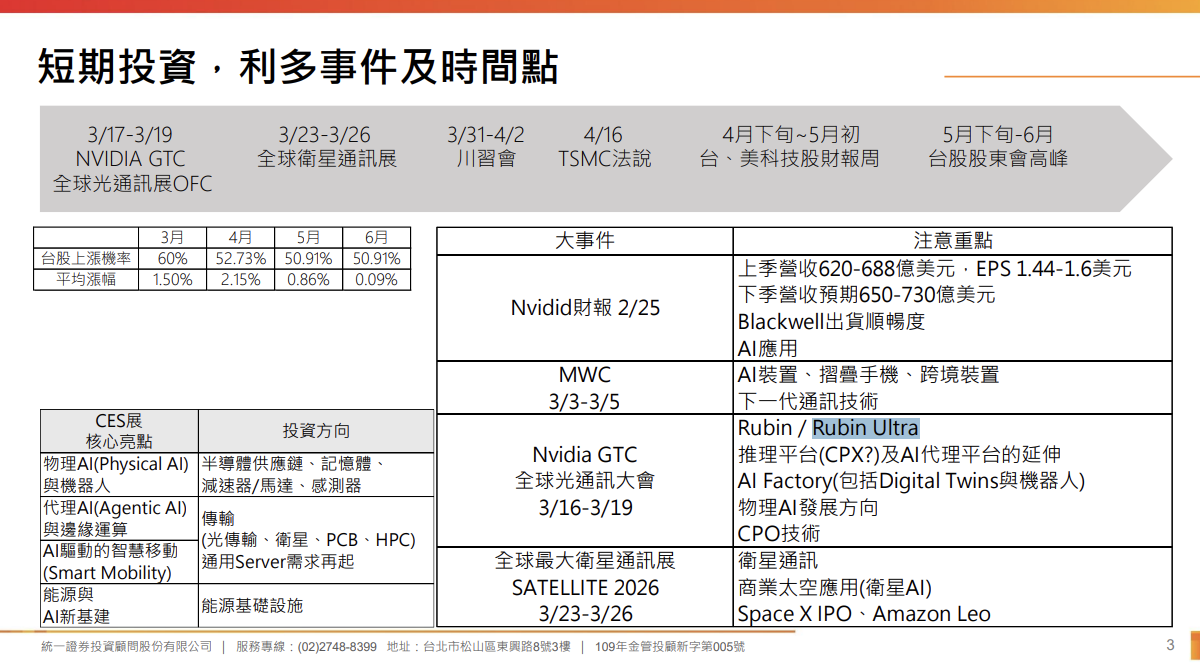
Hello to all you hardworking hardware engineers, layout experts, and thermal specialists! Whenever we read industry reports from foreign investors or investment advisors, the first thing everyone looks for is usually “which stock is about to skyrocket.” But as R&D engineers working our butts off on the front lines, what we should really be looking at is “what new specifications are going to push us to the brink next”—after all, only by thoroughly understanding the technical pain points can we know which stocks to buy to “hedge” against our deteriorating liver health, right? According to the “Taiwan Stock Investment Strategy” report released by Liao Wante, General Manager of Uni-President Securities, on March 6, 2026, capital expenditures by the four major cloud service providers (CSPs) are projected to surge by 60% in 2026. This influx of hundreds of billions of dollars in capital signifies a comprehensive overhaul of AI infrastructure specifications. Today, we’ll delve into this report to analyze the four major hardware design challenges we’ll face from 2026 to 2027, as well as the “heavyweight” suppliers poised to cash in on this boom!
Still worrying about cooling a few hundred watts? Get ready for a much bigger monster.
The report indicates that Nvidia's Rubin Ultra generation, expected in 2H27, will adopt a new Kyber mechanical architecture, with TDP reaching an astonishing 3600W! Traditional air cooling is completely incapable of handling this heat output. The report clearly states that achieving 100% liquid cooling will become inevitable. Next-generation Microchannel Liquid Cooling (MCL) technology will be key to pushing cooling efficiency to new heights.

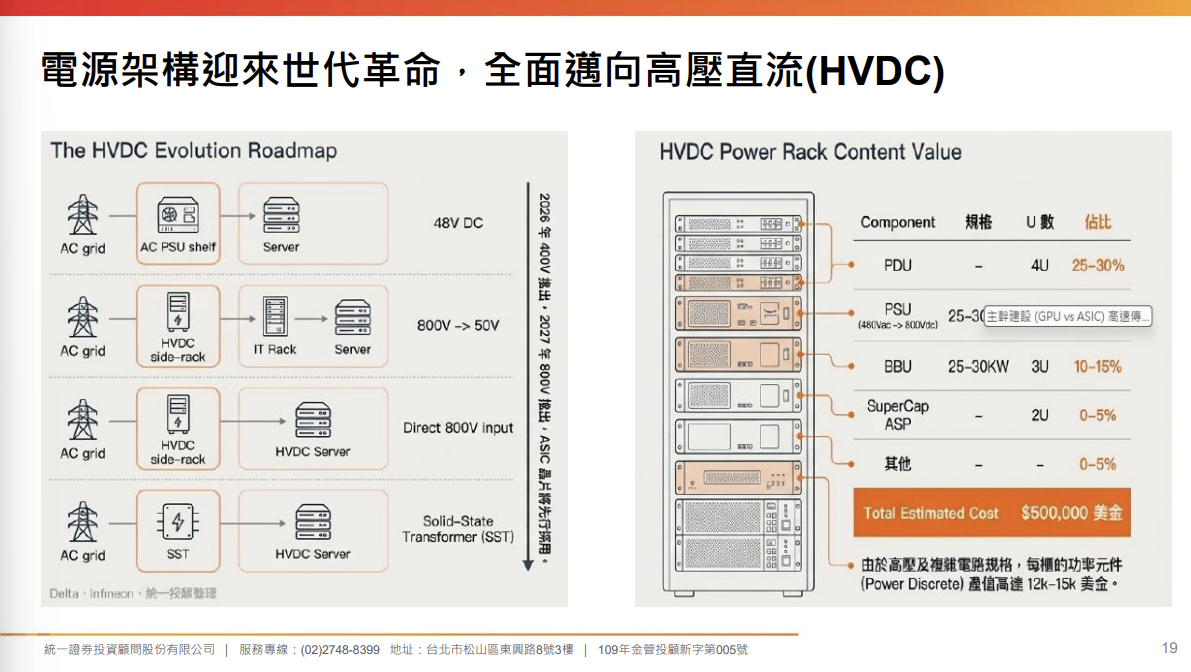
As power consumption surges, Power Delivery architecture is also undergoing a generational revolution:
When AI models require coordination among tens of thousands of GPUs, data center architectures are moving from traditional Scale-Up and Scale-Out into a third phase: Scale-Across. This demands extreme interconnect speeds:
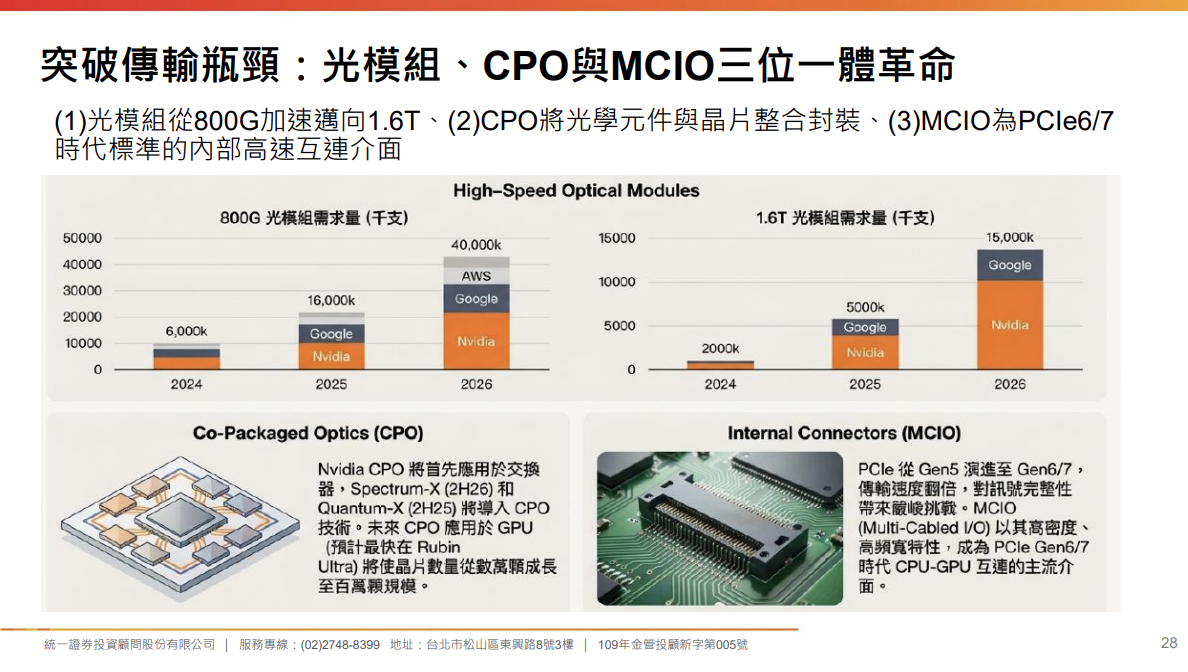
External Interconnects: Optical modules are accelerating from 800G towards 1.6T, and the industry will fully adopt Co-Packaged Optics (CPO) technology, integrating optical components directly with chips. The number of chips is projected to grow from tens of thousands to a million scale.
Internal Interconnects: As PCIe interfaces evolve to Gen6/7, MCIO (Multi-Cabled I/O), with its high density and high bandwidth, will become the mainstream interface for CPU-to-GPU interconnects. For SI engineers, future circuit simulations will only get more challenging.
📈 Supply Chain Highlights (RD's Investment Clues): The optical communication and testing sectors are poised for explosive growth. The report is bullish on Lumen Korea (6442), holding orders from Nvidia and Google; Land Mark (3081), with its InP substrate technology; and Shian Yee (3363), cooperating with TSMC on FAU packaging. On the testing side, WinWay (6515) is highlighted, benefiting from increasing test times.
If you are an existing eCloud customer or a Layout engineer, you need to pay close attention to the following trends. Shortages and price increases for high-end PCB materials will become the main theme of 2026:
Glass Fiber Fabric Upgrade: To meet ultra-high-speed transmission requirements, PCB glass fiber fabric will gradually upgrade from E Glass to Low DK, and even to Q fabric for ultra-high-speed AI PCBs. Glass fiber fabric is now seen as "the next major shortage component" after memory.
Copper Foil Shortage: AI servers require large volumes of ultra-low profile copper foil (HVLP / HVLP4 / HVLP5). Reflecting rising raw copper prices and increased production costs, processing fees for standard copper foil have already increased, and high-end copper foil prices are only going up.
📈 Supply Chain Highlights (RD's Investment Clues): EMC (2383), hailed as "another Taiwanese gem," as the exclusive supplier of M9 material, will be the biggest beneficiary. Among copper foil manufacturers, Co-Tech (8358), with its HVLP4 copper foil fully integrated into the M9 supply chain, is poised for catch-up gains. Major substrate manufacturer Unimicron (3037) is expected to see "price increase after price increase," entering the main upward trend from 2H26 to 2027.
From this investment research report, it is clear that 2026 will undoubtedly be a year of "brutal upgrades" in hardware specifications. From the 3600W liquid cooling limit, 800V high-voltage power, 1.6T optical communication, to the adoption of Q fabric and HVLP copper foil, every aspect tests the design capabilities of R&D engineers.
As hardware engineers, we may not be able to change the ever-looming project deadlines, but understanding technological trends and supply chain directions early might just help us add a little to our own salaries. Fellow engineers, prepare your technical manuals, open your brokerage apps—it's time to level up again!
(Disclaimer: This article is for industry technology trend discussion and information compilation from institutional reports only and does not constitute any financial investment advice. Investing involves risk. Please carefully assess your own situation before entering the market.)