March 27, 2026
Hello everyone! In hardware development, whenever dealing with high-power power supplies, automotive electronics, or designs requiring extremely high thermal dissipation performance, **heavy copper PCBs (typically referring to copper thickness ≥2 oz / 70 μm)** are definitely the engineer’s top choice. However, many procurement and layout engineers are often taken aback when they receive a quote: “It’s just thicker copper—why is a 3-ounce board so much more expensive than a 1-ounce one?” In fact, the cost of heavy copper PCBs follows a “step-wise increase.” The core price difference is by no means solely due to the increased amount of copper; rather, it is determined by four key factors: materials, manufacturing processes, production yield, and design complexity. Today, we’ll thoroughly break down the cost structure of heavy copper PCBs to help you understand exactly where your budget is going!
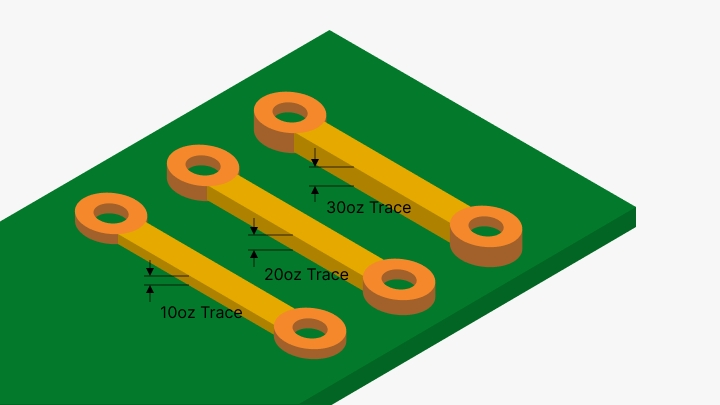
Many assume heavy copper boards are expensive simply because of copper prices. That is only half the story. The increase in material costs includes many hidden factors:
Significant Premium for Copper Foil: Copper foil costs rise sharply with thickness. Taking standard 1oz (35μm) cost (approx. NT$350 / m²) as a baseline, upgrading to 2oz increases cost by about 62.5%; at 3oz the cost jumps roughly 137.5%; for 6oz or more, the copper foil material cost alone increases exponentially.
Complete Upgrade of Base Laminate (CCL) and Prepreg (PP): To withstand the high temperatures generated by high currents, heavy copper boards typically require high Tg (glass transition temperature) and high heat-resistant laminates, which are 15%–30% more expensive than standard FR-4. Additionally, the trenches between heavy copper traces are very deep and must be filled with large amounts of high-resin-content prepreg (PP) specifically designed for heavy copper to prevent lamination voids.
Increased Process Consumables: Plating chemicals, dry film, and solder mask (which may require multiple coats to cover extremely tall traces) all contribute to a 30%–80% increase in total material costs compared to 1oz boards.
Every step in the factory is more demanding for heavy copper boards:
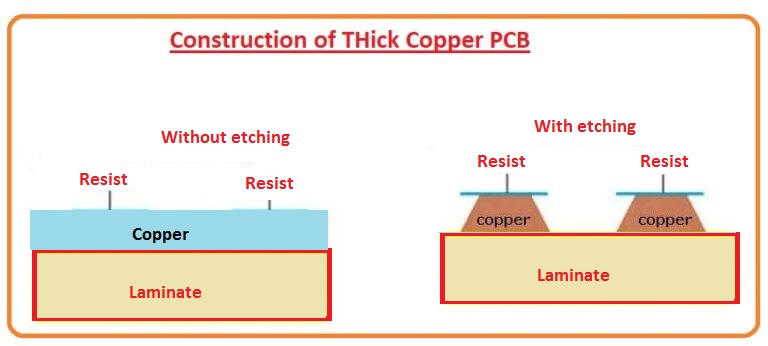
The Struggle of Etching: Etching 2oz copper takes twice as long and costs twice as much as 1oz; for 3oz, segmented etching may be needed, costing up to three times more. Moreover, thicker copper is more prone to undercut, and the yield for boards ≥4oz drops significantly.
Drilling – Equipment Killer: Drilling through heavy copper rapidly wears out drill bits (e.g., drilling 3oz boards wears bits twice as fast as standard). Combined with difficulties in chip evacuation and hole wall quality control, the per‑hole drilling cost can jump from NT$0.4 to NT$1.0.
Lamination Challenges: To achieve perfect resin fill, lamination press parameters (pressure, time, temperature) must be upgraded, leading to a 50% increase in energy consumption and a 40% increase in lamination cost. Multilayer heavy copper boards may even require multiple lamination cycles.
This is often the most painful part of PCB factory quotations. For example, the etching defect rate for 3oz boards can be as high as 8% (compared to about 3% for standard 1oz boards). When scrap occurs, the loss involves very expensive materials.
Furthermore, the cycle time for heavy copper processes is significantly longer, reducing equipment utilization and throughput. Additional rigorous reliability tests and high rework costs are also reflected in the final quotation.
To provide a clearer idea, the following are industry‑wide cost increase references for volume production (compared to standard 1oz boards):
(Note: Each additional 1oz of copper thickness increases the total cost by approximately 10%–18%. If the design is a multilayer heavy copper board (4+ layers), the cost can be 40%–70% higher than a double‑sided board of the same copper weight.)
What if the budget is tight? Focus on these three design principles to effectively reduce costs: