July 20, 2026
Hardware teams in Taiwan face an inescapable reality: relative humidity runs 70–80% year-round, and the core materials of a PCB all absorb water. A board sits in the warehouse two months too long, or a moisture barrier bag gets opened without exposure-time control — then reflow hits, and delamination, blistering, and solder defects arrive together. These failures often get blamed on "fab quality," but the true root cause is usually a broken moisture-management chain. This article walks the full chain: absorption mechanics, MSL classification, pre-bake decision criteria, and packaging and storage practice.
 Nearly all of a PCB's polymer materials are hygroscopic: FR‑4 glass‑epoxy substrates, prepreg, polyimide (PI) films used in flex circuits, photoresists — even uncured solder mask and OSP organic surface preservatives absorb ambient moisture. Polyimide absorbs noticeably more than epoxy systems, which is why flex and rigid‑flex builds demand stricter humidity control. Absorbed moisture is invisible day to day; what it degrades is downstream adhesion, dimensional stability — and most fatally, behaviour under high‑temperature processing.
Lead‑free reflow peaks around 245–260 °C, far above the boiling point of water. Moisture trapped in the board vaporises within seconds, and the resulting vapour pressure ruptures the weakest interface in the layer structure — the "popcorn effect." It shows up as delamination, localised blistering, micro‑cracks, and a family of soldering defects. The slower killer is worse: residual moisture accelerates CAF (Conductive Anodic Filament) growth — a failure mode that never appears in outgoing tests, surfacing months after deployment as intermittent leakage or shorts. A moisture‑saturated board can defeat the most carefully engineered stackup.
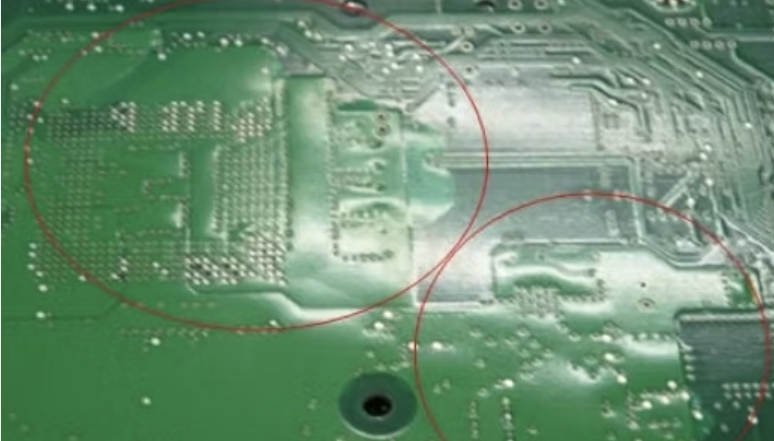
Inside the fab, an entire series of thermal steps exists for moisture: substrate pre‑bake before production, soft/post‑exposure/hard bakes for photoresist, thermal cure of the solder mask, the heat‑and‑pressure lamination cycle for multilayers, and drying bakes after wet processes like plating and chemical cleaning. The practical takeaway for engineers: boards leave the factory dry, and vacuum packaging seals that state. Moisture problems almost always happen after shipment — in transit, in the warehouse, and in every gap between bag opening and the SMT line.
Whether to bake before assembly comes down to three checks: packaging integrity (a torn vacuum bag or a tripped humidity indicator card means action), exposure time after opening versus the control limit, and the temperature/humidity record of the storage environment. Component‑level moisture sensitivity is governed by IPC/JEDEC J‑STD‑033; bare‑board storage and handling follows IPC‑1601:
| MSL level | Floor life after opening (≤30 °C / 60% RH) | | :--- | :--- | | MSL 1 | Unlimited | | MSL 2 | 1 year | | MSL 2a | 4 weeks | | MSL 3 | 168 hours | | MSL 4 | 72 hours | | MSL 5 / 5a | 48 / 24 hours | | MSL 6 | Mandatory bake before use |
Typical bare‑board bake conditions sit in the 105–125 °C range for several hours, with actual temperature and duration depending on thickness, layer count, and surface finish. One frequently missed detail: OSP boards do not tolerate repeated high‑temperature baking — the organic coating degrades in the oven, directly compromising solderability. The right strategy for OSP is to avoid baking through packaging and shelf‑life discipline, not to bake after the fact; when baking is unavoidable, temperature and cycle count must be tightly controlled.
The standard moisture defence is a four‑piece kit: a moisture barrier bag (metalised multi‑layer construction) , a vacuum or heat seal, desiccant inside the bag, and a humidity indicator card (HIC) . Check the indicator card first at receiving — a colour change means the protection has already failed and a bake is needed before the line. Boards opened but not immediately assembled belong in a dry cabinet below 10% RH, with packaging labelled with seal date, MSL, and handling instructions so line operators never have to guess. Given Taiwan's climate, open and mount immediately; anything left over goes into the dry cabinet should be treated as standard procedure, not best practice.

From the fab's bake cycles and vacuum packaging, through warehouse climate control, to floor‑life discipline at the SMT line — moisture management is a single chain, and one broken link wastes everything upstream. The cost asymmetry is stark: a dry cabinet plus an incoming‑inspection SOP, versus a scrapped production lot from delamination or a post‑deployment CAF failure. The math does itself.
eCloud ships with full moisture protection as standard — vacuum sealing, desiccant, and humidity indicator cards — and we regularly help customers run the "board problem or storage problem?" failure analysis. Have aged inventory heading to assembly, or unsure about bake conditions for OSP or ENIG boards? Talk to our engineering team and confirm the moisture risk before the line starts — it's far cheaper than cross‑sectioning for root cause afterward.