I. Global HDI PCB Market Size and Growth Forecast
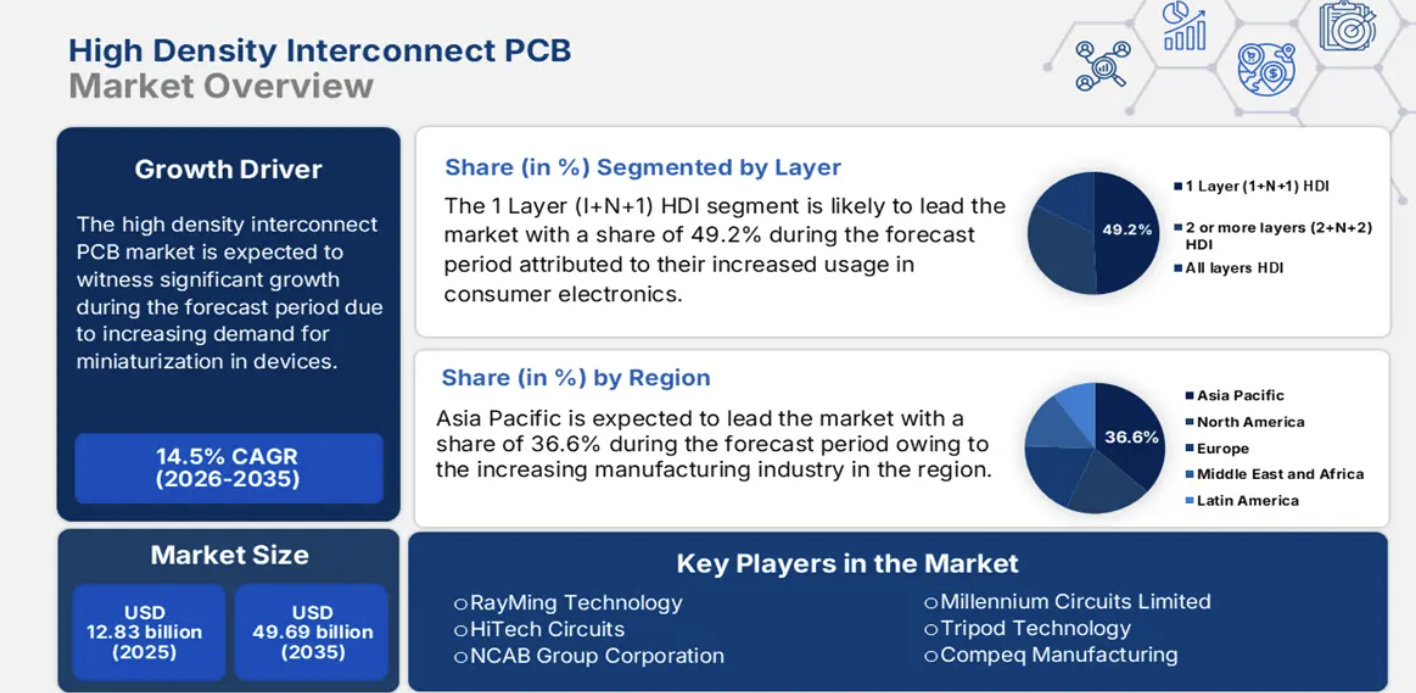
The High-Density Interconnect PCB market is in a phase of rapid expansion, primarily driven by the ongoing demand for miniaturization in electronic devices.
1. Market Size and Compound Annual Growth Rate (CAGR)
- Current Market Size: The global HDI PCB market size is expected to reach USD 1.283 billion by 2025.
- Long-term Forecast: By 2035, the market size is projected to grow significantly to USD 4.969 billion.
- Growth Rate: During the forecast period from 2026 to 2035, the market is expected to grow at a high CAGR of 14.5%.
2. Market Share by Layer Structure
Segmented by layer count, the Single-layer (1+N+1) HDI structure is expected to dominate the market throughout the forecast period.
- Single-layer (1+N+1) HDI Share: Expected to hold over 49.2% of the market share.
- Structural Advantages: This structure is crucial for consumer electronics. Single-layer HDI offers electrical properties with minimal signal attenuation and capacitance, making it highly suitable for high-frequency communications and 5G applications. Furthermore, single-layer HDI boards are more cost-effective than multi-layer HDI boards.
3. Regional Market Share and Key Drivers
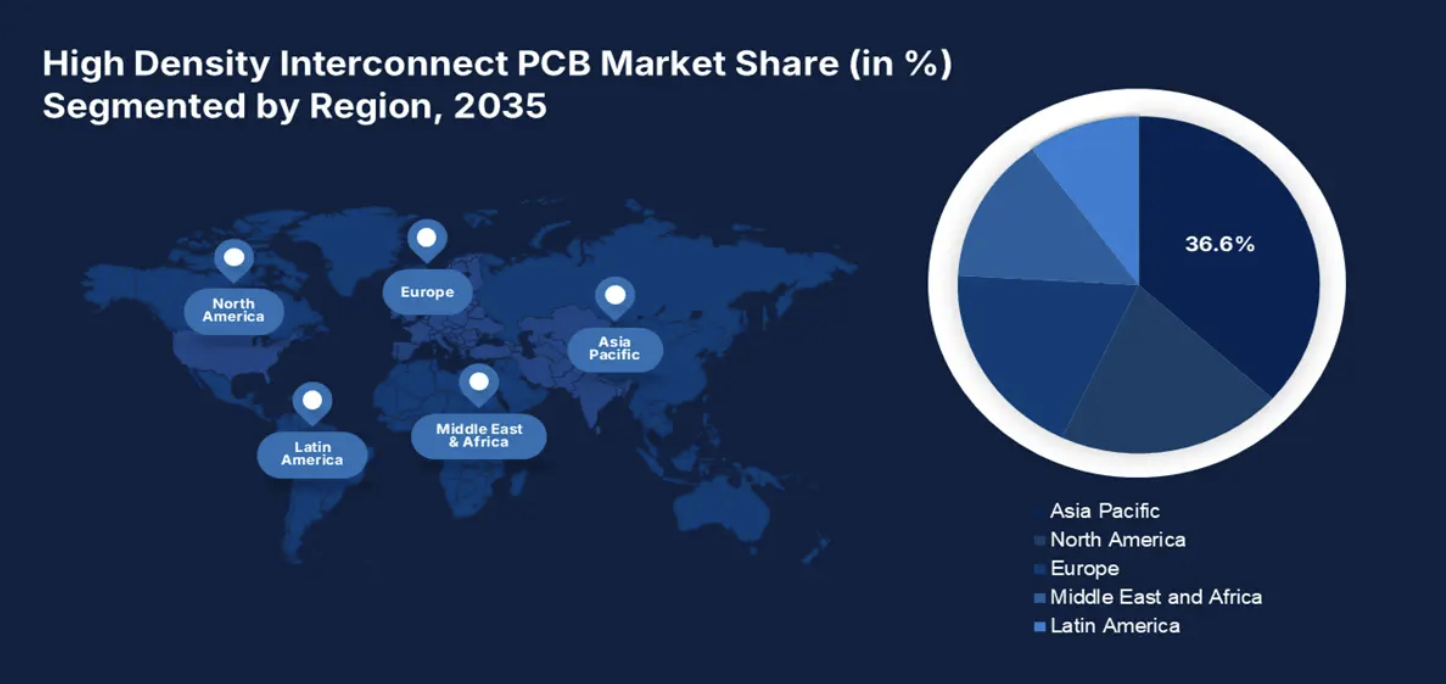
The Asia-Pacific (APAC) region is projected to dominate the global HDI PCB market.
- APAC Region Share: Expected to hold 36.6% of the market share.
- Primary Drivers: This is largely due to the region's growing consumer electronics manufacturing sector, with increasing production demand from countries like China, India, and Japan. Growth in the Electric Vehicle (EV) sector is also driving significant expansion in China's HDI PCB market.
- North American Market Role: Growth momentum in the North American market stems from its emphasis on technology R&D and high-reliability electronics, particularly driven by the automotive, aerospace, and telecommunications industries.
II. Key Growth Drivers for the HDI PCB Market
The strong growth of the HDI PCB market is jointly propelled by technological advancements and consumer demand across multiple sectors.
1. Extreme Demands from Smartphones and Thin/Light Electronics
The mobile electronics market continues to pursue characteristics of being light, thin, and small. The properties of HDI boards perfectly meet this trend. For instance, to achieve slimness, smartphones use HDI motherboards and minimize their area to the extreme, allowing for the configuration of batteries and other modules. Some products already utilize the highest-grade Any-layer HDI technology, maximizing the utilization of the rigid board area.
2. Development of 5G and Telecommunications Infrastructure
HDI PCBs play a vital role in 5G infrastructure and equipment.
- Signal Transmission Requirements: 5G systems need to handle fast data transmission, reduce latency, and enhance communication quality, requiring circuit boards with higher connection density and transmission rates.
- Design Advantage: HDI technology helps further reduce the circuit board volume required for 5G implementation.
3. Proliferation of Internet Devices and IoT
Growth in the Internet of Things (IoT) across smart homes, industrial automation, and smart city fields drives demand for high-density PCBs.
- Functional Requirements: Advanced PCBs enable the enhanced functionality and miniaturization required for IoT applications, allowing more components to be integrated into limited spaces.
4. Automotive Electronics and ADAS System Upgrades
With the acceleration of vehicle electrification and Advanced Driver Assistance Systems (ADAS), the application scope of HDI boards is expanding, making them the fastest-growing type of automotive PCB for the future.
- Application Scenarios: Key drivers include high-performance Electronic Control Units (ECUs), ADAS domain controllers, and automotive camera modules.
- Market Shift: Although internal combustion engine vehicles currently represent the primary application market for automotive PCBs, accounting for 84%, the PCB usage in electric vehicles is 1 to 2 times higher than in traditional vehicles. It is estimated that by 2028, electric vehicles will become the primary application market for automotive PCBs, holding a 63% share.
5. Miniaturization of Wearable and Medical Devices
Wearable devices (e.g., smartwatches/bands) and implantable medical devices demand extreme miniaturization and high reliability from PCBs.
- HDI Meets Demand: HDI satisfies the requirements for high-density integration, thinness/lightness, and high reliability, driving the development of various functional components like cameras, sensors, and processors.
III. Key Challenges Facing the Industry
Despite the promising prospects of the HDI PCB market, the industry faces two core challenges that limit the entry of some manufacturers.
1. High Initial Investment Costs
Manufacturing HDI PCBs requires specialized equipment and technology, leading to extremely high initial investment costs.
- Required Equipment: Precision tools are needed, including laser drilling machines, sequential lamination equipment, and specialized technical personnel.
- Result: These high initial cost factors pose significant financial barriers for small and medium-sized manufacturing enterprises.
2. Longer Product Development Cycles
HDI PCBs have longer development cycles, determined by their complex design and manufacturing characteristics.
- Design and Process Complexity: High-density designs involve innovative technologies like microvias, blind and buried vias, and multi-layer interconnections.
- Testing Requirements: Stringent reliability testing and standards compliance testing must be performed, adding time to the overall development process.
IV. Summary and Outlook
HDI boards are a key cornerstone for the development of modern electronics towards miniaturization and multi-functionality. With the accelerating adoption of 5G, IoT, and electric vehicle markets, the demand for HDI boards is expected to continue rising. As a global leader in automotive PCB manufacturing, Taiwan's PCB industry holds a leading advantage in HDI technology and will continue to benefit from this trend.